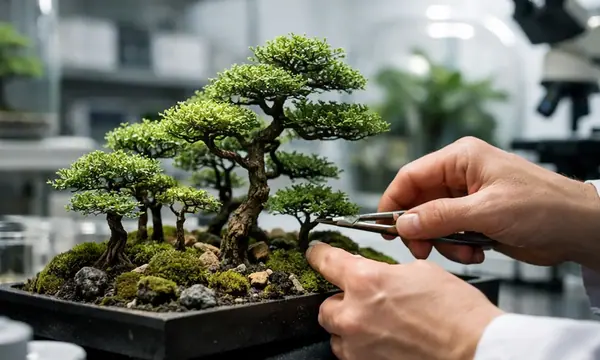
Yose-ue Group planting ―― A big landscape in a small pot
Classification of beauty in the bonsai tree form – Bonsai Styles Bonsai trees bring the beauty of nature right into a small pot by recreating the splendor of foliage from the natural world. The various shapes that emulate natural plants have come to be classified by many bonsai enthusiasts throughout the long history of the bonsai tradition. These form classifications presented herein can be broadly broken up into the two categories of forms natural to the plants and forms steeped in visual pleasure as a result of being accomplished in special natural environments. The bonsai trees you typically see will generally belong to one of the classifications described here. But of course there are bonsai plants that do not strictly fit into these categories, namely plants with characteristics that span several categories in one swoop. While paying attention to the form type is definitely preferable for ensuring that the bonsai grows into a beautiful creation, it is not necessary to confine yourself to the classifications themselves.
Bonsai Styles Classic Bonsai of Japan
Chokkan Formal upright form ――Basis of bonsai style
Chokkan trees stretch to the heavens like a gothic cathedral in a straight upright line. Imagining a cypress or cedar form is the easiest way to explain the Chokkan form. The divine beauty of the Chokkan bonsai, seen stretching straight upward from any angle it is viewed, is breathtaking. People approaching such a tree feel as if they are enveloped under the branches and granted a moment of heart-warming peace. The Chokkan bonsai may seem easy to create because its form is so simple. But its bilaterally symmetric form in a triangular arrangement emanating out from the central trunk spells doom for the visual balance if even one branch dies. It is said that the bonsai tradition starts and ends with the Chokkan form – the Chokkan is considered both the base of all bonsai forms and the most difficult form to achieve as well.
Hokidachi Broom form ――Sweeping the sky
The Hokidachi bonsai gets its name from having a form that looks similar to a "broom" (hoki) with the brush end "sticking upwards" (dachi). The Hokidachi stands upright just like the Chokkan, but the branches start radiating outwards from clustered points of origin midway up the trunk, thin out as they climb upwards, and form a fine semi-circle dome at the top. Perhaps the trees most fit for the Hokidachi style are elms, maples, and zelkovas seen stretching their large limbs magnificently across the sky on tree-lined paths in parks or trails.
Shakan Slanting form ――Unbalanced image of stability
The Shakan bonsai is meant to represent trees growing in harsh environments like the strong winds of a storm swept seashore. The Fukinagashi pays homage to even stronger winds, with a form that stoops to one side. You might sense the strength required to grow in such harsh climates emanating from these trees. The roots on the side opposite of the trunk slant stretch firmly into the ground in order to pull and support the trunk as it is whipped around by the wind. At first sight these trees appear to be unstable. But in truth, they maintain a stable composition through an intricate balance. Can you feel the severe side blowing winds suggested by these bonsai trees?
Moyohgi Informal upright form ――Romantic aura of twisting and bending
In contrast to the Chokkan bonsai, the Moyohgi expresses the beauty of curves in the trunk and branches. Like old trees dwelling in hills and fields, the Moyohgi evokes the dignity, grace, and refinement of trunks and branches that have bent and twisted over the long years. Powerful stability is exuded from the roots to the trunk, with branches springing out from the outside of trunk curvature. The overall tree form is balanced by the length and angle of the branches. In other words, the core stability obtained by balancing the arrangement of complex curved portions is what gives the Moyohgi its beauty. In addition, trees with an even stronger curvature are called Bankan (coiled trunk). As evidenced by their frequent appearance in paintings for stage background designs in traditional Japanese Noh drama performances, Moyohgi bonsai trees are the most well known among the different bonsai types. In fact, they are considered representative of the bonsai tradition. Also, another reason for their popularity is that, excluding cypress and cedar with their tendency to stretch straight upwards, most trees can be made into Moyohgi bonsai trees.
Kengai Cascade ――Overflowing potential of growth
Kengai and Han-kengai bonsai trees are grown such that the trunk and branches stretch down below the roots. They droop down from their pots. The curvature of line in the trunk and branches hanging down at a sharp angle from the pot is the feature point in observation. Kengai is said to be one of the oldest bonsai forms, and is particularly popular in the class of SHOHIN bonsai (small-size bonsai: up to 8” in height). Trees with branches that extend lower than the bottom of the pot are known as Kengai, and trees that do not reach to the bottom of the pot are known as Han-gengai.
When Shohaku (evergreen conifer) bonsai trees strike a Kengai form, they often suggest to the viewer an image of a powerful will to live shooting its roots into the meager soil spotting a sheer cliff and hanging on to life for all its worth in the face of adverse conditions. And when plants that give forth flowers and fruit take the Kengai form, they are frequently said to emit the atmosphere of a tree lazily taking in the warm sunlight and stretching out its limbs to its heart's content.
Sharimiki or Sharikan, or Sabamiki Driftwood ――Weaving of life and death
In the natural world, the Sharikan effect can be seen mainly among large, old conifer trees such as pine, cedar, and juniper. Over hundreds of years, trunks damaged by strong winds, snow blankets, snow slides, or lightening die along with the branches protruding from them. The bark on the dead portion decays and the rigid core of the tree is stripped bare. This process of a portion of a tree living in a harsh natural environment dying and becoming bleached is called Sabamiki or Sabakan. When deadwood is present on the branches as well, the term Jin is used. However, though the tree itself is bleached, a dark brown Mizusui (water path that sucks water from the trunk) remains, and verdant leaves spring plentifully in spots. In the bonsai world, people use knife tools to carve into the trunk and achieve this effect, taking care not to damage the Mizusui. The tree is dead, and yet it is still living. Perhaps this form in which life and death are intertwined and intermingled in the flow of time hints at the meaning of life and symbolizes a subtle and profound worldview of the East.
Bunjingi Literati form ――Tasteful elegance
The Bunjingi bonsai emulates trees growing in the wasteland soil of sandy and barren areas. The trunks are thin from the bottom to top, the branches are thin and sparse, and the overall form is thin and wiry. Moyogi trunks and branches are thinned, and the lower branches are clipped away to reduce the branch count. The origins of this style lie in trees depicted in the sumi-e (sumi ink paintings) brought over from China to Japan along with Zen Buddhism in the 12th to 13th centuries. These tree illustrations captured the hearts of the Japanese people living in those days, and gradually came to be reproduced as bonsai trees. Since ancient times in China, the word "Bunjin" has been applied to the various forms of intellectuals (literati) that created, maintained, and passed down a culture based on rich knowledge and wisdom. The term is found in Chinese written records as early as the 2nd to 3rd centuries B.C. In addition to the fields of philosophy, history, rhetoric, and calligraphy, Bunjin involved themselves in sumi-e painting endeavors such as Bunjinga painting, musical performance arts such as the Chinese harp, pastimes such as the game of go, and arts and crafts pursuits such as seal designs, fashion and interior design, bonsai, and gardening. The typical traits that characterize the Bunjin ideal are, in general, versatility of talent and a wide range of interests, a dedication to the pursuit of tasteful elegance on the level of an artist, the loftiness of soul and anti-conventional spirit of a monk, a need for seclusion, an amateur spirit by avocation, and an appreciation of scenic beauty. Among the Sumi-e paintings brought into Japan was a type of painting known as "Bunjinga," painted by Bunjin as expressions of their philosophies and tastes. Japanese intellectuals of the late 19th century especially identified with the image evoked by these Chinese Bunjin and favored bonsai styles that emulated the Bunjingi depicted in Bunjinga. In the simple and light forms free of all extraneous parts depicted by thin trunks and branches and a minimal branch count, and in the elegance of trunks and branches free to grow out in any direction, perhaps they felt a reflection of free aloofness that transcends desires and the constraints of society. Or, perhaps in these trees they envisioned the peace of mind that envelopes the soul as a result of training in self-improvement conducted in solitude away from the idleness of everyday life. Or maybe they enjoyed these forms because in them they saw the spirit of the Japanese aesthetic of wabi-sabi, wherein the forms and flaws of nature are seen as beauty.
The attraction of the Bunjingi bonsai tree is in its simplicity. Some even say that the ultimate Bunjingi bonsai is a tree with only one branch. Because such simplicity is key, the spatial design sense and technique of the tree artist are incredibly important. And if the resulting tree is elegant, this simplicity is surprisingly complementary to both old Asian style houses and modern building rooms. However, because maintaining the trunk and branches in their thin state over many years is difficult, they are not often seen in such settings.
Sokan Twin-trunk ――A symbol of diverse intimacy
A bonsai tree with one trunk is called Tankan, and trees divided into two or more trunks are classified as Takan. A bonsai tree with two trunks is called Sokan, a tree with three trunks is a Sankan, and trees with five or more trunks are called Kabudachi. All types have an odd number of trunks, except for the Sokan of course. Developing an even number of trunks is not practiced. One reason for this is said to be that Japanese people have preferred odd numbers from days of old. However, the most important reason is the visual design. If the number of trunks is even, the environment inside the pot becomes too organized and sterile, and the sense of presence is limited to the potted space. But odd numbers emanate the scenery into the area outside the pot and bestow a sense of dynamism upon the bonsai. Bonsai trees with many trunks sometimes look like Yose-ue bonsai.
Sankan Triple-Trunk
Kabudachi Multi-Trunk
The Sokan is a bonsai tree with two trunks coming from one set of roots. The tall and thick trunk is called the Syukan (main trunk) and the thin and short trunk is called the Fukukan (sub-trunk) or Komiki (child trunk). The tree is trimmed so that branches from the two trunks do not invade each others' space, and a beautiful balance that allows both trees to stand in harmony is achieved. Do they look like a parent and child standing together, or like an intimate married couple or pair of lovers?
Neturanari Root connected ――An anecdote in the forest
The Neturanari seems similar to the Kabudachi in the sense that multiple trees are connected by one set of roots. It also seems similar to the Yose-ue in the sense that multiple trees are standing side by side. However, in truth this tree is completely different from the Kabudachi and Yose-ue. The Neturanari is meant to represent a small piece of natural history in which a tree is tumbled over by natural forces like snow, wind, or lightning, sinks into the ground, and then starts a little group of trees from the branches in the soil that thicken into trunks-like entities and spring up from the ground – sometimes even building a tiny grove from the remains.
Look at the places where the roots and trunks are linked and at the gaps between the trunks and enjoy searching for a sense of the recreation of a drawn out chronological process.
Neagari Exposed root form --An unintended ensemble of roots
Sometimes floods or mudslides wash away the soil around tree roots, exposing them. When the exposed roots live on after this experience, they are often beaten by the wind and turn into trunks. When this happens to a tree, it is called Neagari. This may seem to be an extremely rare phenomenon in nature, but it happens surprisingly often. Some trees that undergo a Neagari process in the natural world possess such beauty that they could be transplanted into a pot and enjoyed as bonsai.
Roots exposed and interwoven in intricate patterns can display an incredible three-dimensional formative design achieved in nature and exhibit a deep and profound harmony. When creating Neagari as a bonsai, wire is applied to the roots to adjust their shape and the number of roots is cropped through trimming. These processes must be performed over a long period of time.
Ishitzuki Clinging-to-rock or Planted on rock ――More interesting with stone
The Ishitzuki is a bonsai form that recreates the natural scenery achieved when trees and stones reside side by side. Using stone allows the bonsai artist to create a more detailed display of a mountain area, ocean scene, or island backdrop. This makes the scenery even easier to imagine for the viewer. The placement of stone can determine whether a scene is meant to emulate an expansive faraway view or an intimate close-up shot of a small area. The Ishitzuki resembles the Yose-ue in that it is closer to being a miniature reproduction of the natural world. Ishitzuki trees can be divided up into three broad categories depending on the way the stones are used.
The first category is the most representative Ishitzuki. A stone is placed vertically, a very small amount of soil is arranged on the stone surface, and a plant is grown in that spot. The tree is planted so that stone looks like a large rocky formation or mountain. For example, some Ishitzuki trees are meant to be reminiscent of trees growing along rock formations and cliffs in deep mountains and dark valleys, or craggy areas on the seashore beaten by heavy waves. In place of a pot, these trees are planted directly on rocks and placed directly in humidity/drip trays.
The second type involves a rock placed lengthwise just as the first type. However, the form is arranged such that the roots wrap around the stone. Over long years, if the trunk grows to cover the stone and the two forms merge into one, the "aged" aspect is said to be expressed well. This in turn is considered to imbue the tree arrangement with incredible value. Because the tree and stone are arranged in a pot with the soil piled up over the top, the roots extend into the piled up portion of the pot. Maple bonsai trees are often seen taking this format.
The third type consists of plants grown in soil placed on top of a flat, plate-like stone which is used as a pot. A multitude of plants spring up from several roots, just like the Yose-ue. This arrangement can be used to symbolize natural settings such as a remote island floating lonely on the sea, the shore of a river, or an expansive forest scene.
The Yose-ue bonsai is a group of plants emerging from several sets of roots grown in a shallow pot or flat stone meant to symbolize a grove or forest setting. Groups with a small number of plants can resemble Kabudachi bonsai. In the past, the Yose-ue type of bonsai was achieved simply by lining up plants growing in nature. About 70 years ago, the rules of perspective in art began to permeate bonsai culture, and depth and expansiveness in scenery began make themselves known in arrangements. Implementing perspective was an epoch-making event which resulted in Yose-ue taking on a more advanced level of realism. Looking at an example of Yose-ue gives the impression of looking at a real forest or copse of trees. You may sense grandeur of scale completely unexpected given its small size. In the sense of being a miniature recreation of natural scenery, the Yose-ue could be considered the format closest to the intent of the bonsai art form.
Creating the perfect Hokidachi is extremely difficult. A suitable nursery tree must be carefully selected, and proper care must be constantly lavished on the tree for many years. Moreover, sometimes a suitable nursery tree does not appear even after planting 100 seeds.
Copyright : 2009-2010 BonsaiExperience.com All Rights Reserved.
Shaping Aesthetics
TYPES OF BONSAI TREES
Ishitzuki is one of the oldest forms of bonsai, and it is even said by some that the bonsai tradition began from efforts to recreate in pots the natural scenery of stones and trees grouped together. 12th century records indicate that these arrangements were being created in Japan as early as that century. It takes time to create a superb Ishitzuki specimen. When the tree and stone become one after a long period of time and any traces of artificial arrangements made by the bonsai artist are erased, then a true Ishitzuki has been created.